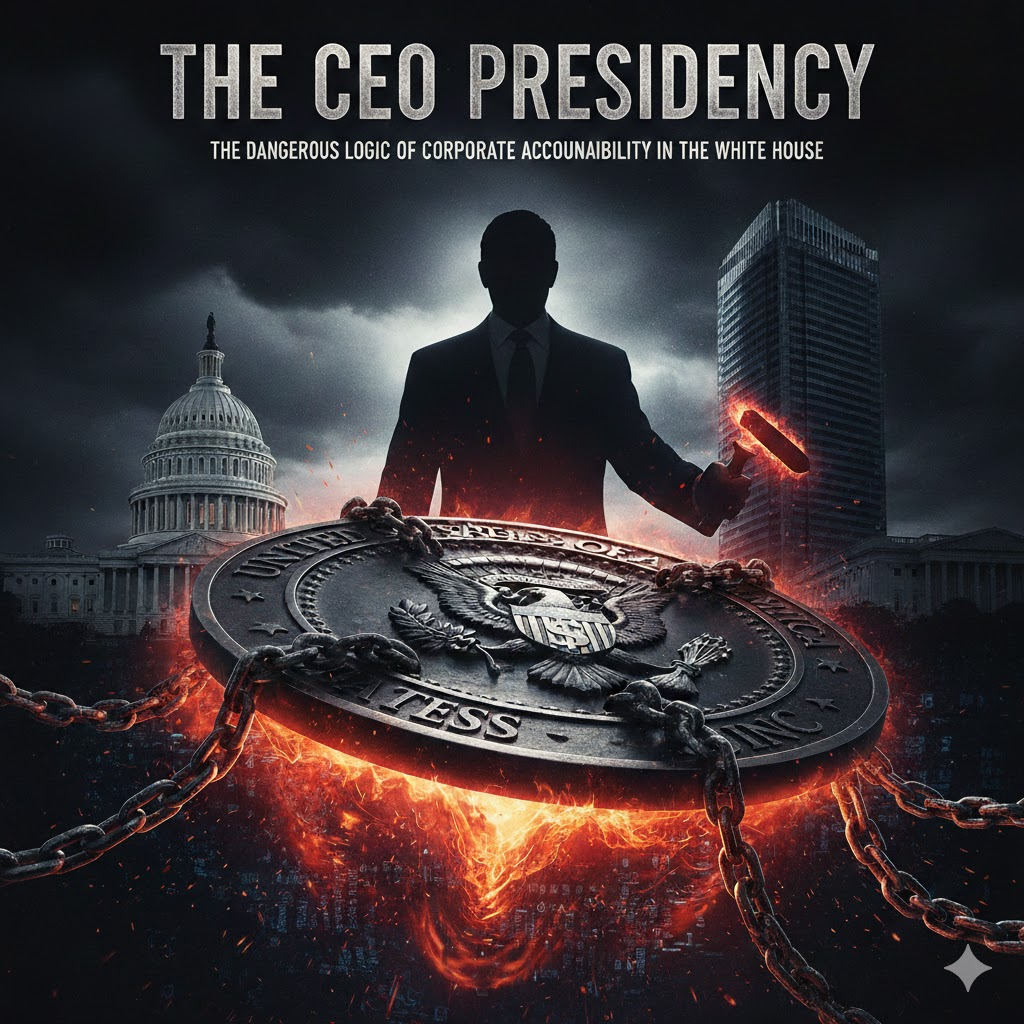
For years, a large segment of the American electorate embraced the idea that government should be run more like a business. The pitch was simple and emotionally compelling: Washington was bloated, slow, and tangled in bureaucracy, and what the country needed was a hard charging executive who would operate like a chief executive officer. That framing was not accidental. Donald Trump built his public persona on being a decisive corporate leader, a brand conscious dealmaker, and a boss who rewards loyalty and punishes disloyalty. In his own business writing, particularly in The Art of the Deal, he emphasizes control of narrative, aggressive reputation management, and tight personal oversight of high stakes matters. When voters chose that model, they also, whether intentionally or not, imported the rules of corporate accountability into the White House.

Understanding corporate structure is essential to understanding how responsibility flows. In large companies, the CEO is not a distant symbolic figure. The chief executive sets culture, chooses senior leadership, defines priorities, and shapes how the organization responds to threats. Sensitive legal issues, public relations crises, and matters that could affect the company’s long term brand value are not left to chance. They are elevated. General counsel, communications executives, and trusted senior advisors brief the CEO, outline risk, and align on strategy. Even when a CEO does not personally draft every memo, the direction is clear: protect the organization, contain damage, and control what becomes public. That is not conspiracy thinking. It is standard corporate governance.

Trump’s management style, both in business and in office, closely tracks that model. He consistently favored personal loyalty as a primary qualification for influence. Advisors who defended him publicly were elevated. Those who contradicted him were marginalized or removed. Decision making was centralized, messaging tightly controlled, and internal disagreement often framed as betrayal. That structure mirrors companies built around a dominant founder or brand personality, where authority concentrates at the top and major reputational decisions reflect the will of the chief executive. Under that system, it is implausible that a politically explosive, legally sensitive, and globally scrutinized document process would unfold without executive level awareness of its contours and consequences.
The handling of records tied to Jeffrey Epstein falls squarely into that category of high risk, high visibility corporate crisis. Epstein’s crimes involved the sexual exploitation of minors and young women, trafficking across jurisdictions, and an international web of wealthy and powerful contacts. The public interest in transparency is not abstract. For survivors, these records represent validation, accountability, and the possibility that those who enabled or benefited from abuse might finally face scrutiny. When large volumes of material connected to that case are reviewed, filtered, and redacted, it is not a routine clerical exercise. It is a strategic decision about exposure, liability, and reputational fallout for individuals and institutions.
In a corporate environment, a review and redaction process of that magnitude would be classified as a top tier risk event. Legal departments would assess defamation exposure and criminal liability. Communications teams would model media response. Senior leadership would weigh political and financial consequences. Most importantly, the CEO would be briefed on the stakes and the recommended path forward. Even if the CEO did not personally edit documents, the boundaries, priorities, and end state would be set at the executive level. That is the chain of command logic that corporate advocates often praise as decisive and efficient.

When this same logic is applied to the presidency, the conclusion is uncomfortable but consistent. Presidents appoint agency heads, influence Department of Justice priorities, and are kept informed on matters with significant political and legal impact. The idea that an issue involving global attention, powerful associates, and potential institutional embarrassment would move through the system with no executive level understanding runs counter to how both corporate and political power typically operate. In the CEO model, leaders do not get to claim ignorance of outcomes that directly affect the organization’s reputation and legal exposure. Responsibility flows upward, not downward.

This is not just a matter of abstract governance theory. It intersects with real human suffering. The victims tied to Epstein’s operation were not political talking points. They were young people coerced, manipulated, and abused by someone shielded for years by wealth and influence. For many survivors, every withheld name and every blacked out section feels like another instance of the powerful being protected while the harmed are asked to accept partial truth. The moral weight of that reality is heavy. When a system prioritizes reputational management over full transparency, it risks deepening the trauma of those already failed by institutions.
There are also individuals who have been identified in various legal and investigative contexts as part of Epstein’s broader network of enablers or associates. Allegations, civil findings, and reporting have named figures such as Leslie Wexner, Sultan Ahmed bin Sulayem, Salvatore Nuara, Zurab Mikeladze, Leonid Leonov, and Nicola Caputo in connection with aspects of Epstein’s operations or logistics, though the legal status and degree of responsibility vary by case and jurisdiction. The larger issue is not the guilt of any single person, but the pattern of influence, access, and insulation that surrounded Epstein for years. When records connected to that ecosystem are filtered from public view, questions of accountability naturally extend to the highest levels of decision making.
Many Americans supported a CEO style presidency precisely because they believed it would cut through bureaucracy and hold institutions accountable. They wanted clear lines of authority and decisive leadership. But corporate structure has a built in trade off. The same concentration of power that allows fast, forceful action also concentrates blame when outcomes appear to protect the organization over the vulnerable. In business culture, a chief executive is praised for strong control in good times and held responsible for major damage control decisions in bad times. The position does not allow selective ownership of only the positive results.

If the presidency is treated as a corner office and the nation as an enterprise, then the logic of corporate accountability follows. A large scale, reputation sensitive information management process tied to one of the most notorious sex trafficking cases in modern history is not a minor bureaucratic footnote. It is the kind of event that, under a CEO model, would be known, shaped, and ultimately owned by the person at the top. Whether through direct instruction or through the culture and expectations set by leadership, the responsibility attaches to the executive. That is the standard corporate America applies to its own leaders, and it is the same standard many voters asked to be applied to government.